How to Make Turkey Stock from Leftover Turkey
Make use of ALL of the turkey leftovers, and end up with a rich, flavorful stock that can be put to use in so many ways (and also frozen!).
Servings: 12 People (makes 4 quarts)
Ingredients
- Turkey bones (leftover bits of meat, scraps and skin from 1 roasted turkey)
- 6 carrots (scrubbed and cut into 1-inch pieces)
- 8 celery stalks (cut into 1-inch pieces)
- 1 large onion (unpeeled and quartered)
- 2 bay leaves
- 1 cup dry white wine (optional)
- 1 tablespoon whole black peppercorns
- 1 teaspoon kosher salt (or to taste; see Note)
- 5 quarts cold water
Instructions
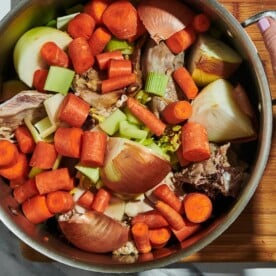
- Place the turkey bones and all scraps into a large stockpot, big enough to hold them with some room to spare. Add the carrots, celery, onion, bay leaves, white wine (if using), peppercorns, salt, and water into the pot. The water should cover the bones, or at least almost cover them, but it should be at least an inch below the top of the rim of the pot. Bring the water to a simmer over high heat, then reduce it immediately and keep the liquid gently simmering. Simmer for 1 to 2 hours, depending on how intense you want the stock. Press the bones down into the stock as it reduces, but it’s okay if the liquid lowers below the top of the turkey bones. Use a spoon to skim any foam that rises to the top off periodically as it simmers.
- Strain the stock through a colander or fine mesh sieve and discard the solids. Cool the stock, then place it in the fridge, either in a large pot or in quart containers. When the stock is chilled scrape most or all of the fat from the top. Use as desired in various recipes. Turkey stock can be refrigerated for up to 4 days or frozen for up to 4 months.
Video
Notes
- The vegetables used in stock can be as simple as onions, carrots, and celery, maybe some fresh herbs. Or you can add a broader range of vegetables.
- If you’re a dedicated stock maker, you can keep vegetable scraps in a sturdy, sealed bag in the freezer. Don’t overlook the stems of fresh herbs and peelings from various cleaned vegetables. Another smart, economical kitchen practice.
- Steer away from very distinctively flavored vegetables like broccoli, asparagus, or mushrooms unless you are prepared for a potently flavored broth. Same for members of the cabbage family, like Brussels sprouts. Be thoughtful about adding garlic, which can tend to overpower the flavor of the stock if used in large quantities. Red beets will affect the color in an obvious way!
- Other ingredients can be added if you intend to use your stock in a particular way. An Asian-inspired stock benefits from the addition of fresh ginger or perhaps lemongrass, for instance.
- Don’t allow the stock to come to a boil. This can cause a cloudy stock and also make it difficult to “defat” the stock later, as the fat will not congeal on top when cooled and be easily removable. Keep the stock at a very gentle simmer, with the bubbles slowly appearing at the surface.
- Skim the stock as it simmers: some foam will rise to the top and can be scooped out as it cooks. It’s not harmful, but skimming as you cook will result in a clearer stock with a cleaner flavor.
- Defat (or partially defat) the stock. Once the stock is strained, allow it to cool completely and put it in the fridge. Once cold, the fat will rise to the top and can be easily scooped off with a spoon. You may choose to leave a bit of the fat, which will make the stock richer when you reheat it. Note that homemade stock will tend to thicken and become a bit gelatinous when it is chilled but will liquefy immediately upon heating.
- To reduce stock after it has been strained and defatted, reheat it in a large broad pot until it reduces to your desired intensity and color. The wider the pot, the more quickly it will reduce. Reducing the stock concentrates the flavor.
- If your turkey was brined or heavily salted, you may need less salt — taste the broth when it is close to done – you can always add more towards the end!
Nutrition
Calories: 35kcal | Carbohydrates: 5g | Protein: 1g | Fat: 0.1g | Saturated Fat: 0.03g | Polyunsaturated Fat: 0.04g | Monounsaturated Fat: 0.01g | Sodium: 238mg | Potassium: 143mg | Fiber: 1g | Sugar: 2g | Vitamin A: 5113IU | Vitamin C: 3mg | Calcium: 31mg | Iron: 0.3mg